

Experience That Matters: Supporting You Through Medical Negligence Claims
Join Simon and Sara from Hatch Brenner Solicitors as they

Written by
Sara Westwood · Partner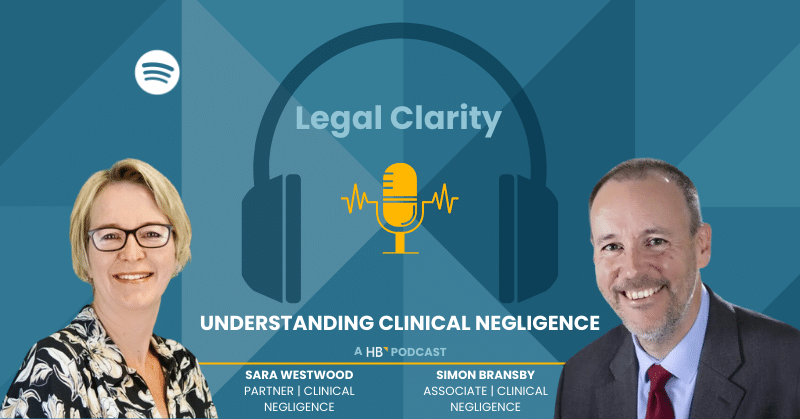
Join Simon and Sara from Hatch Brenner Solicitors as they share their decades of experience and deep passion for helping people through their medical negligence claims.
Full Transcript
Legal Clarity_ Understanding Clinical Negligence – A Hatch Brenner Podcast.mp4
Welcome to Legal Clarity, a podcast brought to you by Hatch Brenner Solicitors. Discover a blend of legal expertise, case studies and real life journeys that will inspire you. This episode features experts from the Dispute Resolution team who will share their insights and experiences, providing you with a clear, concise and comprehensive look at clinical negligence.
I’m Sarah. I’m head of the dispute Resolution department here at Hatch Brenner and I specialise in clinical negligence claims and have done now probably for the best part of 20 years.
Hi, I’m Simon. I’m a chartered legal executive and associate at Hatch Brenner. I’ve been undertaking personal injury work for 35 years or so, and clinical negligence work for ten years. I’ve always had a real passion for helping people. I always wanted a job involving meeting members of the public, and in my clinical negligence work, I’m able to do that. It’s really good to help people put their lives back on track and to help them in a complaint, perhaps to the hospital, maybe trying to obtain an apology and getting back to normal life again after an accident or clinical negligence incident.
I always wanted to do clinical negligence, probably from a very early stage in my career. I love medicine. Just wasn’t clever enough to be a doctor. So I went into the law and fortunately found a firm who also specialises in clinical negligence. So I had very good training and I’ve become quite passionate about helping people with clinical negligence cases. One of the themes that usually comes out of an initial meeting with a client is not so much the compensation issue. If something’s gone wrong, but wanting to try and ensure that the same mistake doesn’t happen again, and that a patient or their family is not affected in the same way. And I think part of being a clinical negligence lawyer is helping the client, not only in terms of trying to recover compensation, to put them back to where they should have been had they not been injured, but also trying to ensure that mistakes are made again and that lessons are learned. So what do you need to prove in order to take forward a claim in clinical negligence. Broadly speaking, there’s two elements you need to prove. Firstly, the breach of duty, which is also known as negligence. And also that the breach of duty has caused an injury. Just perhaps to give you a working example of that. Say you fall off your bicycle on the way into work. You’ve got a very painful wrist. You go into the accident and emergency department. They will probably X-ray it. And in scenario one they say to, you know, your x rays are fine, it’s just a bit of a sprain and sends you home.
When in fact you’ve actually got a fracture. So if you remain in real pain, go back to A&E the next day and they then pick up on the fact that you have got a fracture. Having reviewed the x ray again, they might just put you into a plaster cast and there will have been no impact on the outcome for that injury. The outcome would have been the same whether you’d been treated the day before. Second scenario is that, say, three months go by and you struggle on with a painful wrist just thinking it’s a sprain. Eventually you then have to go back to the hospital because it’s simply not healing. They then identify that there was in fact a fracture, but it’s perhaps gone on to become displaced so that the bones have actually come apart. And you might then need surgery to fix them and might go on to have sort of longer term consequences as a result of that fracture. So the first scenario, though, there was a breach of duty because they missed the fracture on the x ray. There’s probably no claim there because in fact, the outcome for the injury was the same whether you were treated the day before or the day after. There would, however, be a claim in the second scenario, because there you can show that you’ve suffered a poor outcome as a result of the negligence, the breach of duty in not picking up the fracture on the x ray.
I carry out a range of clinical negligence cases, some dental cases I’ve dealt with before. I’ve also had claims where A&E have not properly diagnosed a fracture. For example, I had a lady fall off her horse and A&E didn’t recognise that there was quite a nasty fracture to her eye socket, and she later had to have extensive repair work carried out, which would have been much less significant if it had been addressed sooner. Sadly, I deal with cases where people die, often older people in hospital who haven’t properly been assessed and cared for. They may have dementia. They’re normally the deaths arise as a result of a fall and they may need surgery. I have one at the moment where the lady fell over and had to have hip, a hip replacement carried out, and she sadly died later. I’ve had a claim involving a lady whose partner died, which was a really difficult case, and went on for a number of years. There was not only the claim that she was making, but also the family also were making a claim and required separate representation, and there was difficulties with the falling out of the family in my client. And there was also a potential secondary victim claim on that case, which involved a psychiatric injury to my client as a result of witnessing the death of her partner. And that case, actually, that part of the case failed because the law has recently said that those cases can’t be pursued in a clinical negligence setting. But the overall claim was recently settled for quite a substantial six figure sum, which my client was very happy with.
So we cover a wide breadth of different clinical negligence cases from those that might have a value in terms of compensation of a couple of thousands of pounds to those cases, of a number of millions of pounds, and by way of example, those that may have a value of a number of millions of pounds are often those where there’s been a significant brain injury. I specialise in birth injury claims. So, this is where babies have suffered a brain injury at birth, usually through a lack of oxygen prior to or during the delivery process. I also just to give you some examples of, of cases recently that I’ve dealt with someone who was in hospital for surgery bedbound for a long period of time. And they weren’t turned frequently enough, so sadly developed some very nasty pressure sores. Other examples of negligence. Surgery? I’ve acted for a client who’s having a hip replacement. And because insufficient care was taken during the procedure, they suffered nerve damage, which has caused them longer term disability. In the leg that was operated on I also deal with a few cases where, sadly, the person involved has died. And often the family will come to me for advice, not only on the whether there might be a claim, but also for assistance and representation.
If there is to be an inquest into the death of that person. One recently is where a gentleman in a care home. I’m due to failures to properly assess him, and failures to have a stargate in situ resulted in him falling down the stairs in a wheelchair and sadly dying shortly thereafter. Other examples are delay in diagnosis. So, a client who had a heart scan where there was a failure to properly review the scan. So, there was a delay in diagnosis of the heart defect. And another example is a lady who, during a caesarean section suffered an injury to one of the major blood vessels around the womb, which is a recognised complication of caesarean surgery. So, it wasn’t negligent, but the failure was the fact that they failed to identify the bleed and to repair it before closing her up. She went on to suffer a significant haemorrhage and was subsequently very poorly, but fortunately did eventually make a full recovery. So that’s just a snapshot of some of the cases that I deal with.
So, what can you do if you think you’ve been the victim of clinical negligence? You may want to find out what’s happened. You may want to receive an apology. The starting point can often be making a complaint. There is an NHS complaints procedure which you can follow. It’s available. You can find it on Google. We also have a sample NHS complaints letter on our website. If you find that the complaints process doesn’t give you the answers that you’re looking for or wanting, or it hasn’t been addressed properly by the hospital or other treating people, you could look to ask the healthcare ombudsman to become involved, or possibly GMC or even your local MP.
Once you’ve been through the complaints process, or if you decide that you don’t want to pursue the complaints process and want to seek legal advice, please do give us a call. Simon and I have very experienced legal assistants. My assistant is Donna and Simon’s is Hayley. They will be very happy to speak with you and to take details of the case. We all work very closely as a team, so we will then look at the details of your case. And if you are able to send any relevant documentation to us such as investigation reports that may have been produced by the hospital or the GP practice, we will be more than happy to look over those, for you to look over details of the claim, and then to advise you on whether there is a case there that can be taken forward.

How we can help you
To manage your case, our amiable and approachable partners, solicitors, legal executives, paralegals, and secretaries collaborate actively with you. We also specialise in family, matrimonial, and child law, commercial and residential property, medical negligence, wills, tax and probate, and personal injury.
To find out more about our expertise, please call:
Key Contacts



This article is for general information only and does not constitute legal advice. The law may have changed since publication. Please contact us for advice on your own circumstances.
Keep reading
Related insights



Speak to our team
Discuss your legal requirements with us
Whatever your situation, an initial conversation with one of our solicitors can bring clarity. We will listen, explain your options and be clear about cost from the outset.